Accounts Payable teams spend too much time processing transactions and chasing stalled work, which leaves too little time for decisions that need financial judgment. When a bill falls outside the expected path, such as a vendor that isn't approved, a bill with no purchase order to match, or an approval that stalls, someone has to investigate, follow up, and decide what happens next.
AI agents could take on routine processing and coordination. The design challenge was defining when they should recommend, act, or defer within existing permissions, approval rules, and audit controls, and how people would stay informed and in charge.
Our north star: move AP professionals from doers to reviewers, focusing human attention on exceptions, risk, and judgment.
How I led
As lead UX consultant, I owned the experience strategy across Product, Engineering, Design, Research, and AI, and directed a team of four designers.
Mapped the end-to-end AP lifecycle across five roles to find where work stalled, where decisions happened, and where exceptions needed attention.
Reframed the experience around decisions: what agents could handle, and where human judgment was essential.
Partnered with Engineering to build agent behavior on Intacct's existing roles, permissions, and audit trail, so admins could grant an agent the right to act the same way they grant it to a person.
Challenged our assumption that visible, named agents would build trust, and tested it with 12 customers alongside our researcher.
Defined four principles for human–agent collaboration (Role, Provenance, Agency, Oversight) and applied them across the AP experience.
Extended those patterns to the Finance Intelligence Agent, Intelligent Workspace, and Close Assistant.
Decisions pile up at the handoffs.
We mapped the AP lifecycle across the clerk, AP manager, department manager, controller, and vendor. Work stalled at the handoffs, especially around bill approval and payment scheduling, where someone had to decide what happened next. That shifted our focus from automating tasks to designing around decisions, with AI embedded in the workflow rather than living in a separate destination.

Lifecycle map
We tested our assumption. It was wrong.
We assumed named, specialized agents would build trust. I partnered with our researcher, Melanie, to test that assumption with 12 Sage Intacct customers, comparing a single Copilot concept with a visible multi-agent concept.
The presentation barely registered. 10 of 12 participants didn't notice a difference, and they rated both concepts about the same on control and likelihood to adopt.
What shaped trust instead:
Provenance: 8 of 12 wanted to inspect the data behind an AI response.
Quality: A single poor answer lowered confidence in the answers that followed.
Track record: Half wanted to see the AI work before they were willing to trust it.
"I would want to personally watch somebody go through a whole day of AP entry, with the AI alongside them." — Accounts Payable Manager, research participant
The research changed our direction. Instead of focusing on how agents were presented, we focused on how agents show their work and earn autonomy over time. The resulting model used one Copilot entry point with specialized agents working behind it.
Designing how people and agents work together
Role: specialized agents, one conversation · Provenance: show source and reasoning · Agency: recommend, prepare, then act · Oversight: every action logged, people decide
One place to see what needs attention
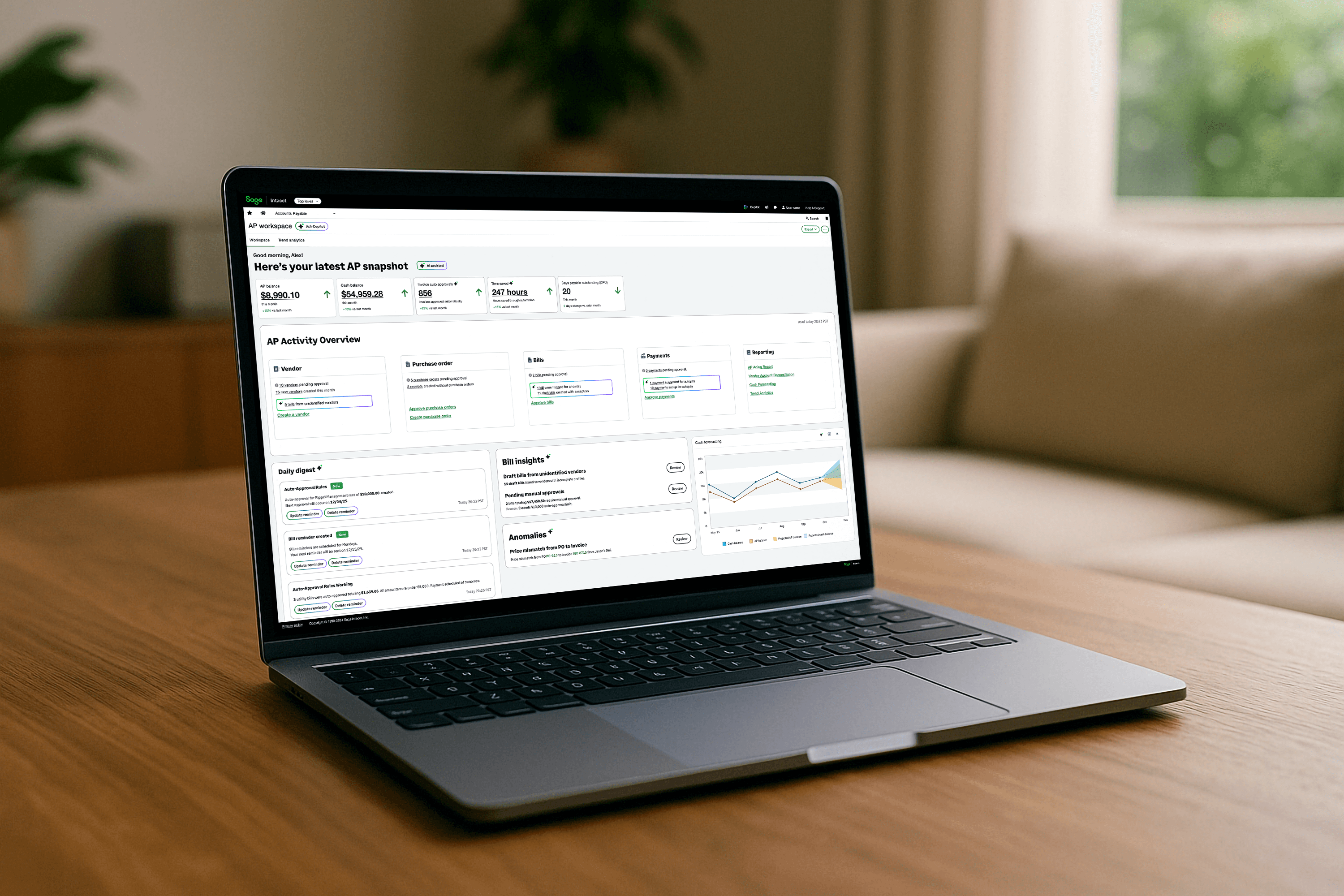
The AP workspace gives clerks and managers a single view of everything blocking their work: vendors waiting for approval, bills without a matching PO, stalled approvals, and payments due. Each area of the AP lifecycle has its own card, and Copilot adds a daily digest, bill insights, and anomalies, so people start the day with exceptions instead of searching for them.
End to end: resolving unrecognized vendors
Ten bills arrive from vendors the system doesn't recognize. None can be approved or paid until each vendor is resolved.
01 · Detect + Explain (Agent): Flags the blocked bills and explains what is preventing them from moving forward.

02 · Recommend (Agent → Person): Proposes secure setup links for each vendor. The clerk decides whether to send them.

03 · Decide (Person): Reviews and approves the banking details vendors submit. This decision stays human. Seven vendors complete setup; Copilot keeps following up with the other three, and their bills stay on hold.

04 · Coordinate (Agent): Links the seven approved vendors to their bills and queues them for posting.

05 · Act + Adapt (Agent + Person): Bills move forward through AP, and future bills from these vendors can be matched automatically. Where the company's rules require it, posting to the general ledger goes to the controller for review.

Two AP decisions instead of a dozen manual steps.
The trade-off
Full automation was technically possible. We deliberately designed agents to start as recommenders and kept sensitive decisions, such as approving vendor banking details, with people. That meant accepting slower efficiency gains upfront so the system could demonstrate reliable behavior before earning greater autonomy. We modeled agent autonomy on Intacct's existing roles and permissions, so admins could grant an agent the right to act the same way they'd grant it to a person. Trust wasn't something we asked people to grant once. The experience had to earn it.
The principles in action
Provenance: Copilot flags a duplicate shipping fee on a vendor invoice. "How Copilot worked this out" shows the bill entries next to the source invoice, so the person can check the evidence before acting.

Agency: When someone keeps approving the same vendor for the same amount, Copilot offers to set up a recurring approval, and the person decides whether to turn it on. In testing, people were comfortable with this for fixed bills like utilities but not for bills that change month to month. So for variable bills, people set a threshold: Copilot auto-approves under it and asks a person to approve anything over it.

From concept to product direction
The work was showcased at Sage Future for Partners in November 2025.
What shipped: Sage has since publicly introduced an Accounts Payable Agent that automates parts of bill processing, matching, and duplicate detection while keeping finance teams involved in review and approval.
What I helped define: The experience strategy and interaction patterns for agentic AP: how specialized agents work across the workflow, expose the source behind their actions, escalate exceptions, and keep people in control through permissions, review, and approval.
Where it was heading: A more autonomous AP experience where agents manage vendor bills from intake through resolution, use repeated approvals and established rules to handle routine work, and escalate exceptions and higher-risk decisions to people.
Patterns that spread
Experience | Principles reused | How it carried over |
Finance Intelligence Agent | Visibility + Agency | Insights connect back to the financial data behind them, while the agent can prepare actions for people to review. |
Intelligent Workspace | Role + Agency | One entry point surfaces each person's priorities while specialized intelligence operates behind the experience. What appears changes based on the person's role and responsibilities. |
Close Assistant | Visibility + Oversight | Close issues surface with supporting financial data and proposed actions for the controller to review. |
For example, Copilot could identify a missing payroll accrual, surface the ADP batch behind it, and prepare a journal entry for the controller to review. Nothing posts until the controller approves it.

What I learned
Test the belief you're most sure of. Our team, including me, assumed visible agents would build trust. Testing it early showed that people cared less about who the agent was than whether they could understand and verify what it was doing.